More
M


Our next collaborating artist, Charles Dickson, shares what you can expect from his colorful room, Play Time, in our newest exhibition in Los Angeles.
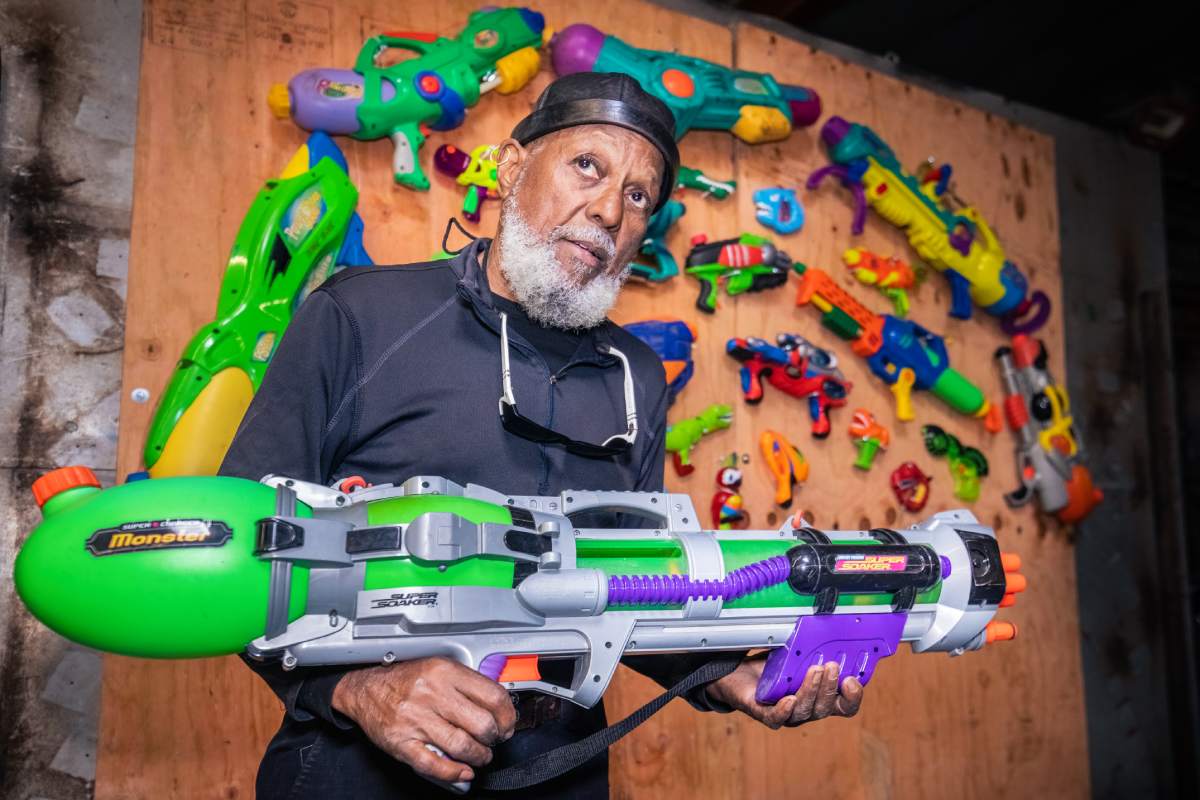
Photo by Carrie Schreck.
Interview transcribed by Rivka Yeker
Opening day at our newest Meow Wolf in Los Angeles is getting closer and closer, here’s a look at who is joining the lineup of collaborating artists. We sat down with Charles Dickson: a man of functional engineering, Super Soakers and color. Discover what he’s excited to share within the walls of Meow Wolf LA:
AJ: Tell us about your room in Meow Wolf LA.
Charles: The room is called Play Time. I thought it was apropos because the Super Soaker, the water toy, was such a phenomenon early on. I started collecting them and I didn’t realize the inventor was a Black engineer. I used to take the water toys and analyze their flaws, like what worked, what didn’t. The way I got into collecting Super Soakers was through a conversation with John Outterbridge about color.
AJ: Oh, wow.
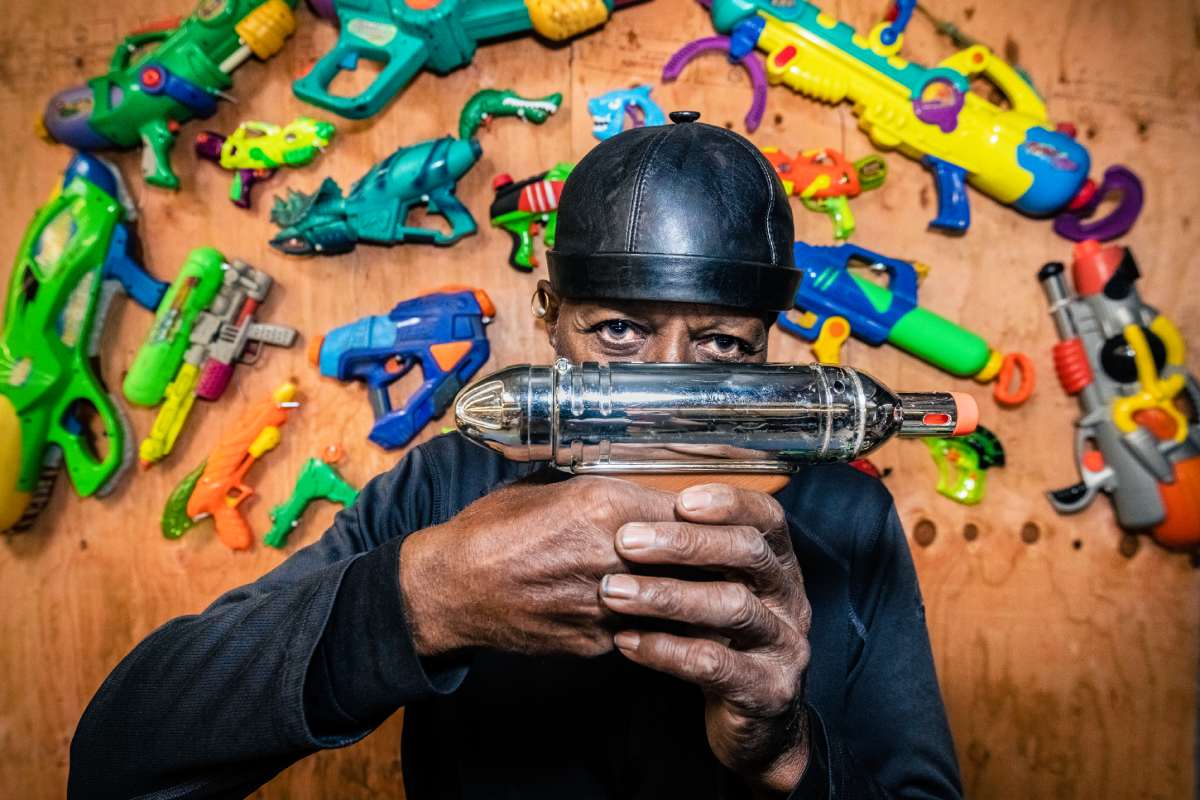
Charles: John has a phenomenal understanding of color. He told me, “You can take little bits of paper in colors you like and collect them in a file.” So I started looking around, and the Super Soakers had all the colors. They’re lime green, yellow – the engineering design is very space like. They’ve even been used in movies as ray guns.
AJ: When you started collecting, did you know it would become artwork? Or were you just buying them?
Charles: I just had an experience with a guy who collected drums, Dr. Joseph H. Howard. He was talking to Sidney Poitier, who was depressed, and he told him, “Get a hobby.” I got depressed once and thought, I need a hobby. So I chose toys.
At first, I collected Star Wars and Star Trek items. Then I had one Super Soaker—a big one—and I thought, this is really cool. It had all the colors. So I started going to every market and store in the area. On my first trip, I must’ve bought 25 Super Soakers.

AJ: Was there one you really wanted? Like something specific for your collection?
Charles: At that time, the bigger the better. The ones they were offering were really big and very powerful. They were closing out stock, so you could go to places like Thrifty’s and find them.
AJ: Like the jet packs and everything?
Charles: Yeah, I remember a jetpack water system meant for four kids. But once you filled it, they’d tip over. Then they came out with better designs. I was into judging how things worked, how they functioned. There was one I really wanted. I eventually ordered it online. It had a backpack with a knob…you could connect a hose and fill it without stopping.
AJ: So you didn’t have to go back and recharge. I remember that… the fun was over once you ran out of water.
Charles: Exactly. Then you’re a target!
AJ: That’s so real.
Charles: One thing about that model, the packaging had a Black kid on it. It was the only one.
AJ: Wow. Can you talk about the inventor?
Charles: Yes! Lonnie Johnson. He was working on a NASA project, a heating and cooling system that required a pump. He was testing something in his bathroom, fired it, and it shot across the room into the tub. He realized it could be a toy. He made one for his daughter’s birthday. Then it took years to bring it to market.
AJ: That’s incredible. I love this because you were the first person to frame it as futuristic for me. And your work already feels futuristic. Through play, you were learning about pressure, engineering, and scientific principles.
Charles: Exactly. Later, when I read his work about valves, I realized I had already figured some of that out. That made me even more excited.
AJ: What do you hope people discover about themselves or about art after spending time in your space?
Charles: That the simplest things are sometimes the most stimulating. Anytime you can have fun and be stimulated by color and utilitarian use, that’s inspirational.
AJ: Beautiful. What’s your connection to LA, and how does the city feed you artistically?
Charles: I was born and raised in LA. I chose to be an artist in junior high. I was already making money selling small things. But there wasn’t really a place to show work. In high school, I started carving larger pieces. I got introduced to shows, won awards, and even received a scholarship to meet Charles White.
AJ: I love him.
Charles: He was my hero. At Otis [College of Art & Design], he told me, “You don’t come here to be an artist, you come here to get your papers and teach.” He said real artists work in garages, under trees…they just do what they do. That shifted everything for me. I also met Danny Johnson, who told me to go to Chouinard [Art Institute] to learn the politics of art. I didn’t understand that until 35 years later.
AJ: Still learning it.
Charles: Exactly. That camaraderie…those people become curators, museum directors. That’s the politics of art. I experienced that firsthand. I had a student applying to Otis—she mentioned my name, and suddenly doors opened. That’s how it works.
AJ: Wow. We talked about this earlier… about how we met and how memorable that interaction was. It means a lot to have you in this Meow Wolf project. Your work is going to introduce new audiences and reconnect others. Do you have advice for artists navigating timing and the politics of the art world?
Charles: Work out of joy. Be patient, but passionate. If those are working for you, and you have a gift, that gift will bring you what you need. Even if it feels like things are breaking down financially or in recognition, if you’re passionate, you keep going. Stay away from destructive paths. Don’t rely on substances to find yourself. Be quiet. Enjoy what you do. Don’t worry about shows or critics. People will always have opinions. You do big work, they want small. You do small, they want big.
AJ: Always.
Charles: But art is always new. It gives to whoever needs it. Critics don’t always see what you actually do. I had to adapt my methods because of illness. I found new ways to work. I always saw myself as being in space, now I look like a spaceman.
AJ: I’m excited for people to experience your work and for future generations to build from it.
Charles: I hope so. One of my goals now is to restore and revisit past work – things from collaborations, from that era. It was a special time, even if we didn’t realize it then. There were people like Cecil Fergerson who would just call and say, “Bring some work to the show.” Without that, we wouldn’t have been seen. We were among the first to show at LACMA, even if it was in the basement.
AJ: Still counts.
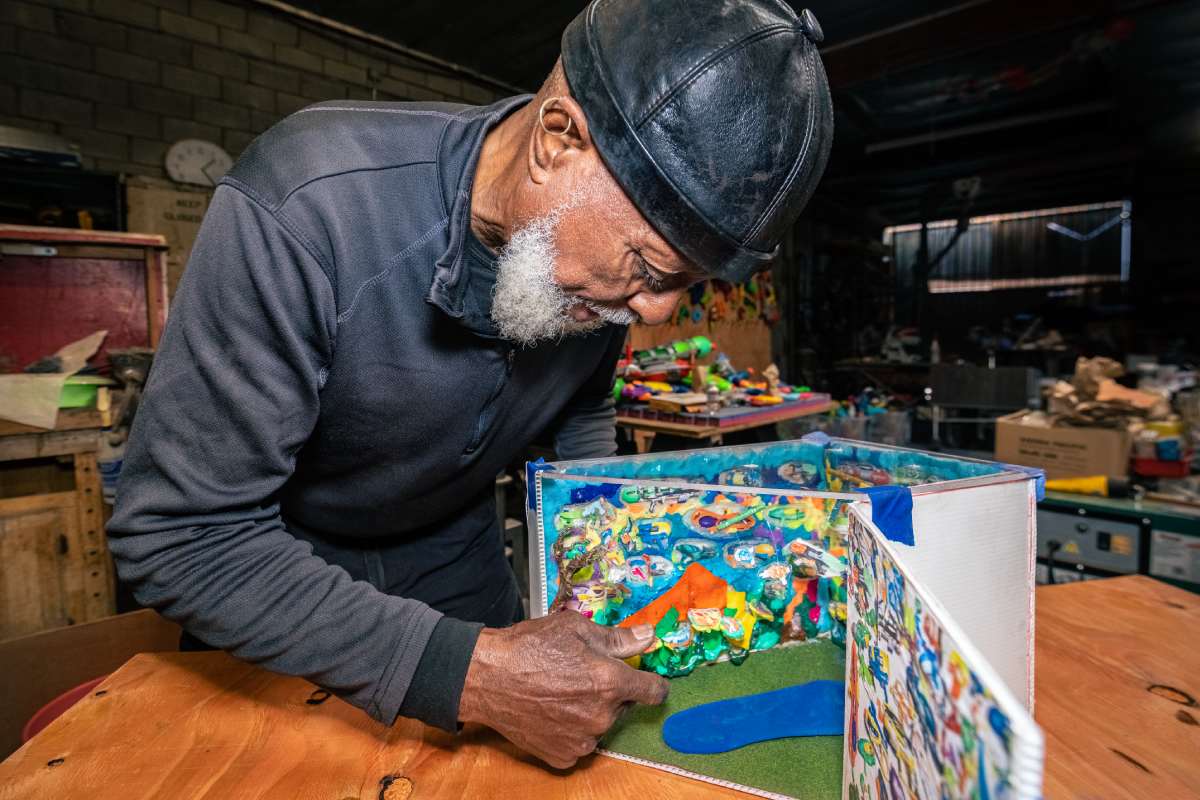
Charles: Exactly. It was a start. With the Super Soakers, I’ve collected so many, in so many designs. I always wanted to show them, to let people experience the joy of design and color. Now I finally have that opportunity. My technology has caught up. I can blend materials – like this new epoxy putty I’m using. It’s fireproof! I tested it with a torch.
AJ: Of course you did.
Charles: That’s part of the process – experimenting, tinkering, making models.
AJ: That’s the joy.
Charles: Exactly. And I have a friend who knows Lonnie Johnson, he might even come to the opening.
AJ: That would be incredible. This is what it’s about – past, present, future all connecting.
Charles: It’s interesting to have been part of that early beginning. I wasn’t always in the center, I was on the side, but I crossed over, learned from people. At the same time, I was isolated. I thought everyone carved wood like I did.
AJ: It’s the lineage. That’s why your use of plastic now feels so powerful…it carries history differently.
Charles: Exactly.
AJ: Meow Wolf is about that too – found materials, reimagining value.
Check out Charles’ installation at Meow Wolf Los Angeles later this year and you can follow his artistic journey on Instagram. For more updates and announcements, subscribe to our emails.



.jpg)