

More
M


If you plan on visiting House of Eternal Return in Santa Fe any time in the future, you may want to check out these places throughout New Mexico.

Contributing author: Tamar Wittenberg
If you plan on visiting House of Eternal Return in Santa Fe any time in the future, you may want to check out these places throughout New Mexico.
In this article we are picking some of our favorite tourist destinations, all of which are right here in New Mexico. Our home is a place of very strange and wonderful things that often escape people’s notice. The state of New Mexico is vast and populated by visionaries with talents and obsessions that are beyond the pale.
There are fascinating things to be found here and we’ll show you a few of them. If you plan on visiting House of Eternal Return any time in the future, you may want to check out these New Mexico tourist attractions as well.
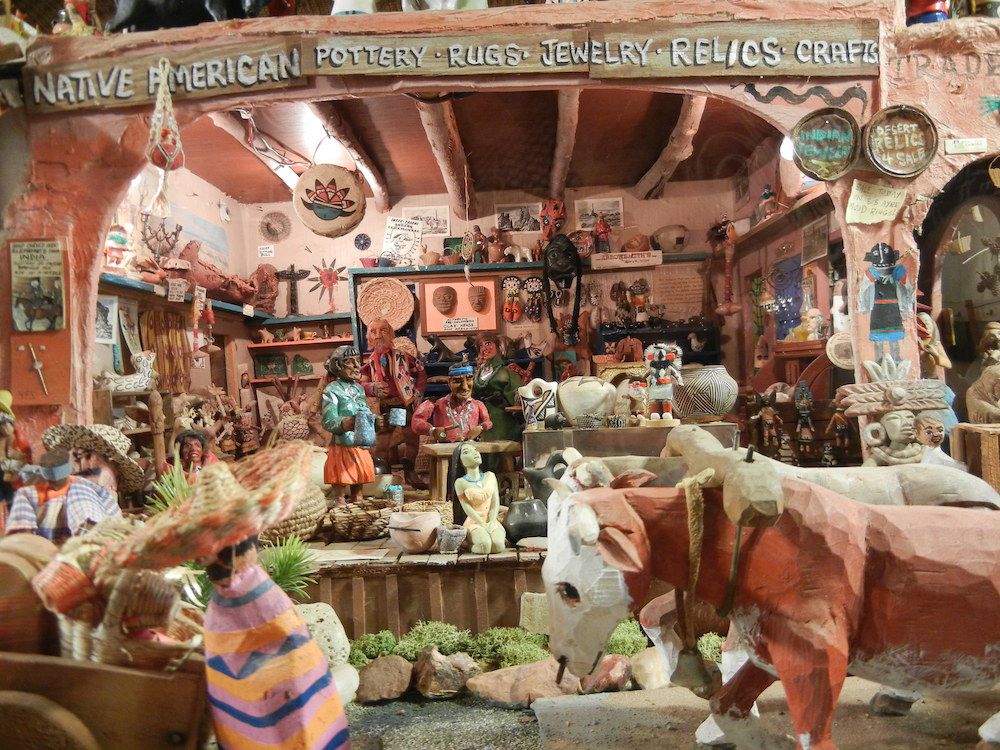
If you’re familiar with Musée Mécanique in San Francisco, a collection of vintage mechanical carnival attractions, then you’ll feel at home at this New Mexico tourist spot in Sandia Park. Tinkertown is similar, but with the important distinction that it blurs the boundaries between the attractions and the viewer. Most old carnival amusements are modular, made to fit in a small box, but the mechanical scenes of Tinkertown are vast and sprawling. They’re jam-packed with detail, requiring time to take everything in.
My favorite piece from the collection depicts the battle of good and evil, an apocalyptic scene with skeletons, devils and grim reapers crawling all over a graveyard like a folk art version of Hieronymus Bosch. On top of a mountain surrounded by flashing bolts of lightning, God and Satan have a tug of war with a recently departed soul, a distressed-looking old man (What does that say about dualism?). It comes on as endearing and humorous, but there’s also drama and some serious eschatological questions lurking within the piece.
Much of Tinkertown came from the late Ross Ward, who began carving miniatures for a general store in 1962. His museum was never truly finished; Ward just added to it throughout his life. This means that visitors can witness the evolution of one oddball artist’s creative life in the course of one visit, a rare treat.
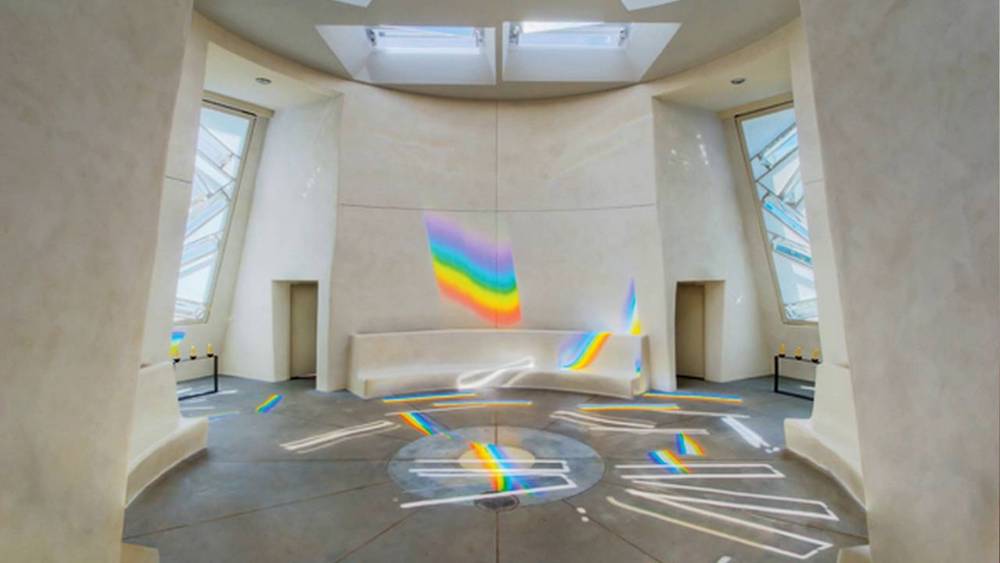
The United World College houses the Dwan Light Sanctuary, a multicolored rainbow room that exists for the singular purpose of making you chill out. Conceptualized by Virginia Dwan, the sanctuary was built by Laban Wingert in 1996 with light displays by Charles Ross. Natural sunlight passes through six prisms in the building, creating rainbow effects that have been showing up in our friend’s Facebook profile pictures for years. The rainbows move through the whole sanctuary over the course of a day.
It casts a very broad, inclusive net for its purpose. It’s there to give people a space apart where they can relax and reflect in whatever way they need to and I admire that. It exists for service instead of dogma.
Perhaps the best-known work of land artist Walter De Maria, The Lightning Field promises one hell of a show if you’re lucky. This New Mexico tourist spot features exactly 400 polished stainless steel poles arranged in a grid covering one mile by one kilometer. The poles are exactly the same diameter and height — 20 feet, 7.5 inches tall and 2 inches in diameter. Their tips create an even horizontal plane across the field. The Dia art foundation claims that the site stands up on its own as a sculpture and I agree, but the hook is that the poles light up during lightning storms. Seldom do sculptures look this dramatic. People often think of artists as channeling some power beyond themselves to create their work and that idea couldn’t be more explicitly executed than it is here.
An opportunity to view this attraction is both rare and expensive. Reservations must be booked with Dia months in advance and tickets for one night range between $100 to $250. There are accommodations in a tiny cabin nearby. It’s an effort, to be sure, but I imagine seeing this work of art light up would feel like winning the lottery.
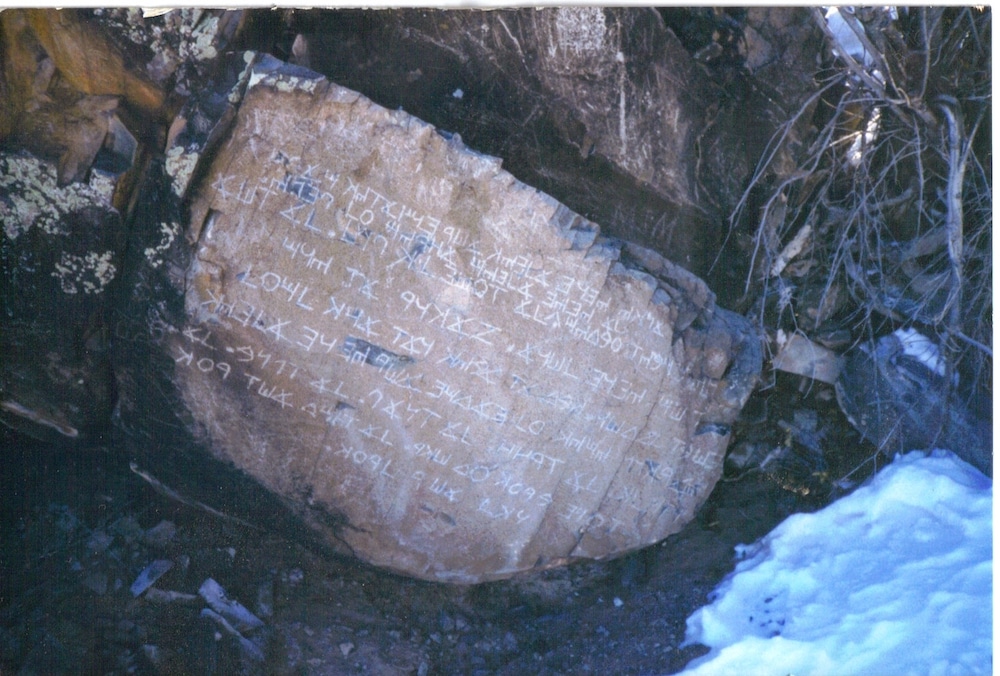
The Mystery Stone of Los Lunas deserves a place on the New Mexico tourist map of high strangeness alongside Roswell and the Taos Hum. A flat stone in the side of Hidden Mountain outside of Los Lunas has cryptic characters scratched on its surface. New Mexico is famous for its ancient petroglyphs, but this appears to be a written message. What it says depends on who reads it, it seems. People aren’t even in agreement as to when it was discovered. Credit typically goes to UNM archeology professor Frank Hibben, but there are reports that the stone was a known quantity as early as 1880.
As for its message: if any of the theories were true it would be cause for some serious rewriting of history. Some claim it’s a version of the Ten Commandments written in a very old version of Hebrew. A still-wilder claim is that the text is ancient Greek and details the story of a sailor who somehow became marooned in the Americas and had to fight for survival in the desert of New Mexico. As is usually the case with odd relics, I don’t care if it’s a hoax or if either strange theory is true. The poetry of such things is that they are inscrutable. They preserve a sense of mystery and otherworldliness that seems to be missing from mundane life. I think the people who perpetuate hoaxes understand this better than most and I’m grateful that no one ever claimed responsibility for it.I understand that visitors to the site are required to pay a $25 land use fee. I suggest checking in with the rangers ahead of any trip into the wilderness.
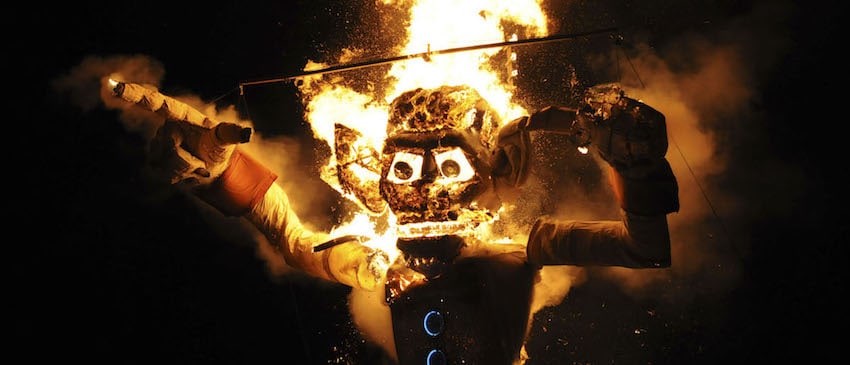
Will Schuster’s anarchic flaming puppet from 1924 is one of the staples of New Mexico tourist attractions each summer. It’s such a simple concept, but in many ways it's the beating heart of what makes Santa Fe such a strange and wonderful place to call home. Zozobra is the manifestation of gloom. A 50-foot tall, ghastly white, howling monstrosity; he’s the representation of every lousy thing that’s happened to us over the last year. And we burn him alive. Grim? Maybe. Fun? You have no idea.
Imagine thousands of people crowding in the field around Zozobra, all of them in on the gag as they chant “Burn him!” The theater surrounding Zozo is earnestly absurd. Someone comes out with a long scroll and reads the charges against Zozobra. There are dancers. Someone dressed in flaming reds and oranges acts as Zozobra’s executioner. A member of the Kiwanis club takes a microphone backstage and acts as the “voice” of Zozobra (I hear this is a coveted job), growling and howling as the fire travels up two long fuses and catches the marionette on fire. Zozobra burns over the course of several minutes, his head collapses to the ground in a pile of ash, we cheer and go home. That’s the main event, anyway. At least half of the fun can be found outside of Zozobra at friendly gatherings, backyard barbecues and dance parties both before and after the event. It’s an unofficial holiday for Santa Fe, the day the entire city pats itself on the back. The artists of Meow Wolf, especially those of us who grew up in Santa Fe, owe a debt to Zozobra for showing us how squishy and permeable reality becomes when confronted with a large-scale art project.
Don’t forget to check out our Santa Fe city guide for other great things to do on your visit.
This other-worldly badlands in Northwest New Mexico is a tourist spot known for its mushroom-shaped sandstone caprocks that seem to defy gravity. They were naturally shaped over 75,000 millenia by wind, water, and ice, transforming them into bizarre shapes known as hoodoos.
The region was originally prospected by a dinosaur hunter who found remains of a dinosaur from the Cretaceous Period. Since then, the remains of fish, crocodiles, turtles, and plenty of petrified tree stumps have been discovered on its lands.
While fossil collecting isn’t permitted there today, Ah-Shi-Sle-Pah Wilderness Study Area offers unreal sights for the adventurous to explore. Prepare for a few-mile hike from the parking area, and be sure to bring plenty of water and sunscreen.
Located just northwest of Taos, New Mexico, the Greater World Earthship Community is home to over 100 off-grid homes known as Earthships. These eco-friendly dwellings are made of recycled materials like old tires, cans, glass, and plastic bottles. They utilize solar heating and cooling, wind-generated electricity, water harvesting, and other forward-thinking techniques to create virtually no waste.
Earthships’ appearances are as striking as their sustainable practices. Their organic shapes, colorful facades, and expansive windows are captivating and unique. See them for yourself on a self-guided or docent-led tour, or experience the earthship life by renting one for a several-night stay.
Common among the American West, ghost towns are formerly-thriving cities that have since been abandoned, leaving behind buildings, homes, and even belongings. They’re an often-eerie glimpse into the lives lived before us.
Glenrio ghost town is a New Mexico tourist place situated along Route 66. It straddles the New Mexico-Texas state line. Once home to a number of local businesses, a motel, and several gas stations, today only a few buildings remain. Visit the abandoned diner, old motel, and a few old cars seemingly frozen in time.
Built by the people of the Southern Ancestral Pueblo, the Gila Cliff Dwellings are a collection of homes built into the side of a cliff in the Gila National Forest. Using tree rings from the wood beams inside the dwellings, experts date these cliffside homes back to 1280.
Archaeologists believe the Gila Cliff Dwellings served as a home for 8-10 families over one or two generations. Their south-facing construction allowed sun during winter and shade in the summer. The lakes beneath provided water for drinking, farming, and attracting local game.
Today, the homes are open to visitors, who are able to wander through several of its rooms, communal spaces, and ceremonial spaces. Take a 45-minute guided tour to learn about the lives of their inhabitants.
Loretto Chapel is home to one of Santa Fe’s most peculiar New Mexico tourist attractions: the miraculous staircase. Originally built in 1878, the chapel was constructed with a choir 22 feet above ground, and no space left for a standard staircase to access it. Thus begins the legend of the spiral staircase.
As the story tells, the Sisters of the chapel prayed to the patron saint of carpenters for a solution. On their last day of prayer, a carpenter appeared at their doorstep looking for work. He built the chapel’s spiral staircase, then left before the Sisters could pay him, never to be found again.
The mystery of this staircase lies within its construction. It’s built without nails or any visible supports, defying every rule of physics and earning it the name of the Miraculous Staircase.
Of course I'm going to close out this piece with HoER! In 2016 a succession of miracles led to my 150 friends and I opening our first permanent art exhibition. Santa Fe geek culture hero George R.R. Martin supplied us with a bowling alley, which we used to tell the story of the Seligs, a family gifted with supernatural creative powers.
The centerpiece of the exhibit is their Victorian mansion, which is under quarantine by a shadowy organization known as The Charter. By exploring the home, visitors learn more about the family and why The Charter considers them a threat. It could have something to do with the portals to other dimensions that are connected to the home. The different portals follow dream logic. The fireplace links to a cave system with a Mastodon skeleton. The path from the upstairs leads to tree houses in the canopy of a neon forest. The refrigerator (perhaps the most photographed one on Earth) takes guests to an interplanetary travel resort.
While critics and art writers scratch their heads trying to describe what we're up to, I'll end with what I consider to be the themes of the House: Mundane reality seems rigid and dull, but that's not the truth. Through our applied creative efforts we can change reality and open portals to any conceivable way of being. There is no auteur, no one person you can call the mastermind of the work. There is only creative chaos as dozens of people follow their artistic obsessions and, through collaboration and mutual respect, build a better world. The coolest part is that everyone has this gift. Everyone has creative chaos; it's the most powerful force humanity possesses. Use yours and see where the portal takes you.
Thanks — Billiam Rodgers



.jpg)

.jpg)